Ecommerce Doesn’t Fail at Sales. It Fails After the Sale.
You did not start an ecommerce business to spend your day chasing deliveries.
But somehow, that is where many founders end up.
Many ecommerce founders assume their biggest challenge is getting more customers. However, in reality, the challenge usually appears after customers arrive. Sales can grow faster than systems can handle. Marketing can perform well while operations quietly struggle in the background.
At first, deliveries are manageable, and you handle it as it comes. However, as orders increase, your systems are more vulnerable. It is important to have a delivery-ready system if you are looking to grow and scale in the 21st century.
What a Delivery-Ready Checkout Actually Does
The ecommerce cycle for your customers doesn’t end at payment, it continues all the way to delivery. A delivery-ready checkout helps you to continue the entire process.

It captures a proper address, calculates delivery costs in real time, assigns a courier automatically, and triggers shipment without anyone manually stepping in. At the same time, the customer receives tracking details immediately, rather than waiting for updates later.
In other words, the order is not stuck, it continues to move without any manual input from you. So if your checkout still ends with “thank you for your order,” then what you really have is only half a system. The rest is still manual.
The Point Where Most Ecommerce Systems Start to Break
Interestingly, most ecommerce systems do not fail immediately. Instead, they start to break quietly over time.
When order volume is low, manual processes feel flexible. You know your customers, so you manage things mentally. You respond quickly, and everything feels under control.

However, as orders begin to grow, that flexibility lapse is more dangerous. Fulfillment begins to lag behind sales, delivery updates become something you have to chase, and customers start asking questions that take time to answer. Gradually, the business shifts from running smoothly to constantly reacting.
This is usually the point where founders realize something important. The problem is not effort, it’s in systems.
Why Logistics Becomes a Bottleneck at Scale
This is exactly where platforms like Shipbubble become important.
Rather than treating logistics as something you figure out after checkout, it becomes part of the checkout itself. As soon as payment is confirmed, the order is already in motion. Pricing, courier selection, routing, and tracking all happen quietly in the background without manual coordination.

Because of this, the business no longer depends on the founder to push every order forward.
Instead, the system carries that responsibility.
Why Developers Benefit From a Plug-and-Use Logistics Layer
Shipbubble is not only useful for business owners. Developers benefit from it as well.
Instead of building logistics infrastructure from scratch, they can plug into an existing system. There is no need to design routing logic, manage courier networks, or maintain delivery workflows internally.
Instead, it simply fits into the existing stack and handles fulfillment in the background. As a result, developers can focus on building product features, improving user experience, and scaling the core application, rather than spending time solving logistics complexity.
In many cases, it removes one of the most difficult parts of ecommerce engineering entirely.
What Changes When Fulfillment Becomes Automatic
Once this is in place, the entire experience of running the business starts to change.
You are no longer manually assigning deliveries, calculating shipping costs after checkout, or responding to constant “where is my order” messages throughout the day.
Instead, those processes are handled in the background.
Because of that, what remains is a business that feels lighter, more predictable, and easier to scale.
You Don’t Need to Build Logistics Infrastructure From Scratch

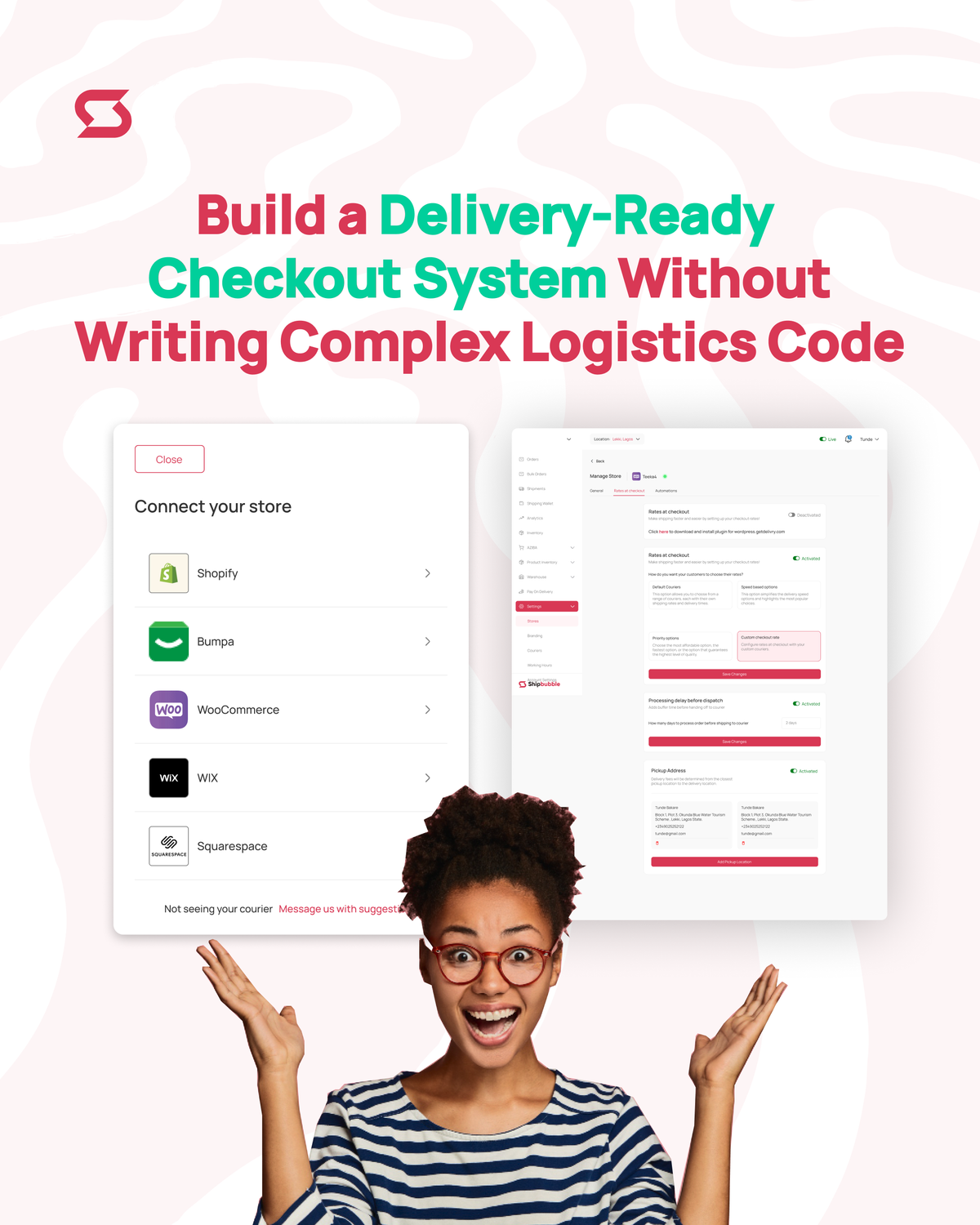
At this point, it is important to be clear about something. You do not need to build courier systems or write complex logistics logic to achieve this. Instead, a delivery-ready checkout is about connection, not complexity.
A customer places an order, the system sends the details to Shipbubble, delivery options and pricing come back instantly, a shipment is created automatically, and tracking is shared with the customer without delay.
That is the full loop. Nothing more complicated than that.
Delivery Is Not an Afterthought in Ecommerce
This is why delivery cannot be treated as something that happens after the sale.
Instead, it is part of the experience the customer is actually paying for.
A delivery-ready checkout simply acknowledges that reality and builds it into the system from the beginning. And that is exactly what Shipbubble enables.
Once checkout and delivery are properly connected, growth no longer feels chaotic. Instead, it becomes structured, predictable, and easier to manage.